Indholdsfortegnelse
ToggleAI Breakthroughs 2026: The Biggest Breakthroughs That Matter Right Now

The era of flashy, experimental AI demos has officially ended. In 2026, the focus has shifted entirely to functional utility. The most significant advancements aren’t just making headlines; they are fundamentally rewriting how we work, create, and solve complex problems in our daily lives. From autonomous agents managing multi-step workflows to multimodal models that see and hear as we do, this article cuts through the hype to highlight the real-world developments that are currently transforming industries, and how you can leverage them to save time and increase productivity.
That shift to delivering real-world impact matters more than hype. The big story right now is usefulness, because the most important AI breakthroughs 2026 are the ones people can trust, afford, and use every day.
Key Takeaways
- AI agents have evolved from prompt responders to practical digital colleagues that handle multi-step workflows, use tools, and execute tasks with lighter supervision, reshaping teams by offloading repetitive work.
- Multimodal AI seamlessly processes text, images, audio, video, and screens, making creation, search, and analysis more natural while raising new trust challenges with synthetic media.
- Smaller, efficient models and on-device AI deliver fast, affordable, private performance for everyday tasks, mixing with larger models for optimal results without constant cloud reliance.
- In science and health, AI accelerates drug discovery, data analysis, and lab automation, supporting experts rather than replacing them, with human oversight essential for high-stakes decisions.
- Practical value trumps hype: focus on tools that save time reliably, build trust through verification, and see repeated use in real workflows.
AI agents are getting useful, not just impressive

A year ago, many AI tools could talk well but needed constant direction. In 2026, the biggest jump is that more systems can plan steps, use tools, and finish tasks with less babysitting, contributing to the broader category of innovative machine intelligence.
That is where the term “AI agent” starts to mean something practical, often referred to as digital colleagues in everyday use. An AI agent doesn’t only answer a prompt. It can break a job into parts, check a source, open the right tool, and return with a result that saves real time.
From answering questions to actually doing the work
The shift is easy to see in daily tasks. Instead of asking for a summary, you can ask an AI agent to watch a project inbox, pull the key points from new messages, sort them by urgency, and draft replies.
The same pattern now shows up across software. AI agents can compare prices, track inventory changes, update records, prepare meeting notes, or monitor a dashboard and flag unusual changes. In coding, they leverage repository intelligence to assist in software development by inspecting a codebase, suggesting fixes, running tests, and explaining what broke, even through emerging vibe coding where they interpret intent over strict syntax. In admin work, they can gather details from several apps and turn them into one clean update.
For many teams, that means less copy-and-paste work. It also means AI feels closer to a junior assistant than a search box.
A simple way to see the difference is this:
| Older AI tools | AI agents in 2026 |
|---|---|
| Wait for one prompt at a time | Handle multi-step workflows |
| Mostly generate text | Use apps, tools, and memory |
| Need frequent guidance | Need lighter supervision |
| Help with ideas | Help with execution |
The takeaway is clear. AI agents are useful when a task has repeatable steps and a clear goal.
What AI agents still get wrong in 2026
Useful doesn’t mean reliable in every case. AI agents still make bad assumptions, choose the wrong tool, miss a hidden detail, or act with too much confidence.
That matters most in high-stakes work. Legal review, medical decisions, financial approvals, and security actions still need a person in the loop. Even a small mistake can spread fast when an agent touches several systems at once.
AI agents save time best on structured work. They still need human review when the cost of an error is high.
Judgment is the weak spot. An agent may finish a task but miss context that a person would catch in seconds. That is why the best use cases in 2026 are narrow, well-defined, and easy to verify.
This workforce impact is already reshaping teams by offloading repetitive tasks to AI agents, freeing humans for higher-level strategy and creativity.
Multimodal AI is changing how people create and search

Text-only AI now feels limited. The bigger advance is multimodal AI, which means one system can work across text, images, audio, video, and live screen input in the same conversation, enabling multimodal reasoning across different data types.
For everyday users, this changes search and creation at the same time. You can show a chart, ask what stands out, attach notes, and then ask for a plain-English summary. That feels far more natural than switching between separate apps.
One model can now see, hear, read, and respond
This is one of the clearest examples of the year’s progress. A single foundation model can read a report, inspect a screenshot, listen to a voice note, and answer based on all of it.
That helps in simple ways. A student can upload a graph and get an explanation. A marketer can speak an idea, attach a rough image, and ask for copy that matches the visual tone. A support worker can share a product photo and get a likely troubleshooting path.
Live screen understanding is also growing. Some AI systems powered by foundation models and computer vision can watch what is on your display, explain what a setting does, or help you finish a task without a long back-and-forth. Because of that, AI starts to feel less like a separate tool and more like a layer across your devices.
AI video and voice tools are improving fast
Voice generation took a major step forward. It sounds smoother, more expressive, and more natural than even a year ago. That helps with dubbing, narration, customer service, and accessibility.
Video tools have improved too. Short clips, talking avatars, automatic editing, and translated content are faster to make. Small teams can now produce content that once needed a studio, a voice actor, and an editor.
Still, the same tools raise hard trust issues. Fake audio is better. Fake video is better. Cloned voices can sound convincing enough to fool people in the wrong context.
So the promise is real, but so is the risk. As these tools spread, proof of source matters more than polish.
Smarter models are becoming cheaper, faster, and more personal

Raw model power still matters, but efficiency matters more in 2026. Better training methods, smaller models, and faster hardware are making strong AI more affordable.
That changes who gets to use it. Big budgets still help, but many useful AI tasks no longer need the largest models running in the cloud every second.
Small AI models are now good enough for many real jobs
This is one of the quiet reasons AI adoption is rising. Small language models now handle a lot of useful work well enough, especially when the task is focused.
They can draft support replies, classify emails, rewrite product copy, suggest code, summarize calls, and run search help inside apps. For many businesses, “good enough, fast, and cheap” beats “best possible, slow, and expensive,” helping to alleviate token anxiety.
That doesn’t mean the biggest models are no longer useful. They still win on hard reasoning, broad knowledge, and long tasks. Yet many day-to-day jobs don’t need the heaviest system. They need a model that responds fast and stays within budget.
As a result, companies are mixing tools more often. They use compact models for routine work and stronger models only when the task truly calls for it.
On-device AI is improving privacy and speed
Phones, laptops, and edge devices can now run more AI tasks locally, thanks to advances in edge computing and AI infrastructure. That means some processing happens on your device instead of going out to a distant server.
The benefits are simple. Responses can be faster. Sensitive data may stay local. Offline features improve. Costs can drop because every action does not require cloud compute.
This matters for note summaries, voice features, photo search, live translation, and Personal Intelligence. It also matters in places with weak internet or strict privacy rules.
The trade-off is that local models are still more limited than the biggest cloud systems. Even so, for private and everyday tasks, on-device AI is becoming one of the most practical changes people can feel right away.
The biggest real-world AI breakthroughs are happening in science and health
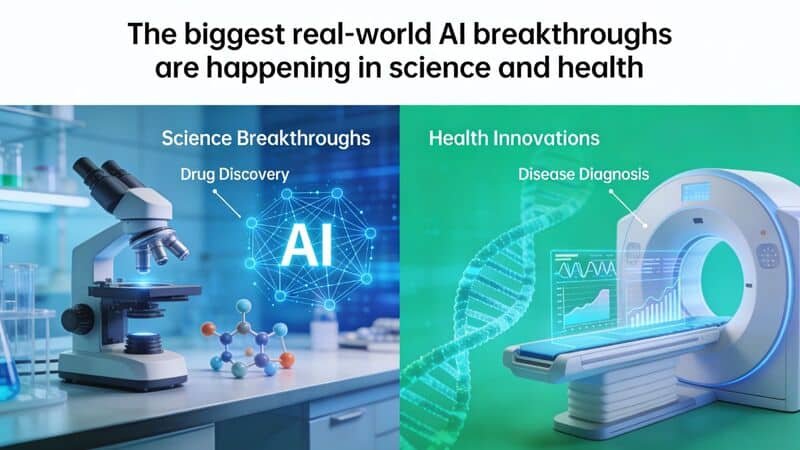
Consumer AI gets the most attention, but some of the most meaningful progress is happening behind the scenes. In science and health, AI is accelerating scientific discovery and achieving medical breakthroughs by helping experts move faster through large, messy sets of data.
That doesn’t mean AI replaces doctors or researchers. It means the tools can reduce slow manual work and highlight patterns that deserve a closer look.
AI is speeding up drug discovery and medical support
Drug discovery is still slow, expensive, and complex. AI helps by narrowing the search. It can suggest promising compounds, model interactions, and shorten parts of early research.
In health care, healthcare modular architecture enables better integration of medical data, while AI tools also help with record summaries, image review support, scheduling, and admin tasks that eat up staff time. In some cases, they can flag patterns in scans or patient data for a clinician to review.
The key point is oversight. Medical AI can support decisions, but it should not make them alone. When the data is incomplete or biased, the model can miss the mark. The best systems work as aids for trained people, not stand-ins for them.
Science tools are helping researchers test ideas faster
The same pattern shows up in labs and research groups. AI can help design experiments, sort findings, analyze huge data sets, and run simulations faster than older workflows allowed.
Materials research is a good example. AI can search through large sets of possible combinations and point scientists toward stronger candidates for batteries, chips, or other products. Physical AI and humanoid robots are now being used in laboratory environments to handle dangerous materials safely.
Autonomous robots are also making strides, using simulation technology and digital twins to test experiments virtually before physical execution. This approach lets autonomous robots execute tasks with greater precision and speed. Lab automation speeds up repeat tasks, which gives researchers more time for thinking and less time for routine handling. Researchers are looking toward quantum advantage to solve even more complex biological puzzles.
That is why this matters. Progress comes from better tools in the hands of experts.
What matters most as AI gets more powerful in 2026

The next phase of enterprise AI adoption will depend less on surprise and more on trust. People want tools that work, but they also want clear limits, safer defaults, and better ways to check what is real.
Trust, safety, and AI-made content are now major issues
As AI-made text, audio, and video spread, proof becomes part of the product. Watermarking, source tracking, and verification tools matter more than they did when synthetic media was still easy to spot.
Bias also remains a real issue, along with cybersecurity threats, data governance challenges, prompt injection attacks, data leaks, and poor transparency around how some systems were trained. Managing supply-chain risk has become critical. For businesses, security review is no longer optional. For everyday users, digital literacy is part of basic online safety.
If you can’t tell where content came from, you shouldn’t trust it at face value.
The smartest way to keep up with AI right now
The best way to follow AI in 2026 is simple. Watch what people use repeatedly, not what trends for one weekend.
Want to stay updated and learn how to apply these AI breakthroughs in real life? You can find more articles and practical tips on our blog:
Pay attention to four things:
- Where AI saves time without adding new risk
- Which tools people keep after the free trial ends
- How often outputs need human correction
- Whether the product gets faster, cheaper, and easier to trust
Hands-on testing helps more than headlines. A flashy launch can grab attention, but steady use is what matters.
These developments represent the peak of generative AI utility. The main achievements are clear: more capable agents, better multimodal systems, smaller and faster models, and stronger tools for health and science.
The most important takeaway is practical value. The headline story is no longer what AI can show off in a demo. It’s where foundation models deliver real-world impact and become useful enough to stay, cementing these as the definitive AI breakthroughs 2026.
AIGrow - Klar til fremtiden
Vi sikrer fremtidssikkerhed for din digitale tilstedeværelse med indhold, der er skabt til både søgemaskiner og mennesker. Uanset om du har brug for blogindlæg, webstedskopier eller SEO-optimering, leverer vi varig værdi på dit foretrukne sprog.

Scan QR-koden
Med AIGrow får du det bedste fra begge verdener:
Gennemgå QR-koden hurtigt for at få en endnu nemmere måde at få adgang til professionel SEO- og AEO-indhold på dit foretrukne sprog.

Frequently Asked Questions What makes AI agents useful in 2026?
AI agents now plan steps, use tools like apps and repositories, and complete tasks such as sorting emails, updating records, or debugging code with minimal guidance. They excel in structured, repeatable work like admin or coding support, acting like junior assistants. However, they require human review in high-stakes areas to catch assumptions or context misses.
How does multimodal AI improve daily workflows?
Multimodal systems handle text, images, audio, video, and live screens in one conversation, enabling natural tasks like analyzing charts with voice notes or troubleshooting via screenshots. This reduces app-switching and boosts creation for marketers, students, and support teams. Advances in voice and video generation add speed but heighten risks from convincing fakes, making source verification critical.
Why are smaller and on-device AI models a big deal?
Small models perform well on routine jobs like summarization or classification, offering speed and cost savings over massive cloud systems. On-device processing enhances privacy, enables offline use, and cuts latency for features like photo search or translation. They complement larger models, allowing hybrid setups that fit budgets and needs.
How is AI driving breakthroughs in science and health?
AI speeds drug discovery by modeling compounds, supports medical tasks like scan reviews and admin, and automates labs with robots and simulations. It uncovers patterns in vast data, freeing experts for strategy while physical AI handles hazards. Oversight remains key to address biases and incomplete data.
What should people prioritize when adopting AI in 2026?
Seek tools that deliver repeated, verifiable value with low error correction needs, focusing on time savings without added risks. Prioritize trust features like watermarking and security against biases or attacks. Test hands-on: steady use after trials signals real impact over flashy demos.